There are three ways of counting compensatory time in terms of holiday entitlement:
- Periods counted as full-time work for the purposes of holiday entitlement
- Time credited up to 20 times the weekly working time
- Periods not counted as work
Compensatory periods fully credited for holiday entitlement are periods when the employee does not work for the reasons listed below and yet this time is fully credited as time worked for the purposes of holiday entitlement (Art.348(1) of the Labour Code):
- Taking leave (this includes both regular leave and additional leave)
- Public holiday - the employee does not work on this day because it is a public holiday, but his salary or wages are not reduced for this day or he is compensated for the day not worked
- Compensatory leave taken for working on public holidays or overtime
- Temporary incapacity for work as a result of an accident at work or occupational disease
- Maternity leave
- Parental leave in lieu of maternity leave - this is time when a man takes parental leave at a time when the employee (the child's mother) would be entitled to take maternity leave
- Self-study - applies to teaching staff (based on Act No. 563/2004 Coll., on teaching staff)
- Nursing a child under 10 years of age or another household member under Section 39 of the Sickness Insurance Act
- Provision of long-term care pursuant to Section 191 of the Labour Code (hereinafter referred to as the Labour Code)
- Obstacles to work on the part of the employee (as defined by Government Regulation No. 590/2006 Coll.) or on the part of the employer (excluding obstacles to work caused by weather conditions)
- Exercise of a public function (§ 201 ZP)
- Exercise of civic duty (§ 202 ZP)
- Other acts in the general interest (§ 203 ZP)
- Duty-related leave (§ 204 of the Labour Code)
- Obstacles at work due to training, other forms of training or study (§ 205 ZP)
The obstacles to work on the employer's side that are fully counted as work performance for the purposes of holiday entitlement include:
- Downtime (§ 207(a) of the Labour Code)
- Other obstacles on the employer's side (§ 208 ZP)
- Partial unemployment (§ 209 ZP)
Important personal obstacles set out in Government Regulation No. 590/2006 Coll. are:
- Medical examination or treatment
- Occupational medical examination
- Interruption of traffic or delay of means of transport
- Making it impossible to travel to work
- Wedding
- Birth of a child
- Death of a family member
- Accompaniment
- Funeral of a fellow employee
- Moving
- Finding a new job
AVENSIO SW programme
Regarding the counting of compensatory time, the program looks at the entry of the above mentioned reasons for absences:
- At Exclusion from status (Employee tab - Employment Relationships - tab Employment Relationship - Exempt from status) :
- e.g. at maternity leave (exemption type 2 - Maternity leave)
- u parental leave instead of maternity leave (Exemption type No. 13 - Parental instead of maternity).
- To the bookmark Replacements (Employee card - Employment - Compensation tab) On:
- Taking regular and additional leave
- Self-study
- Training
- Barriers on the part of the organisation (employer)
- Obstacles on the employee's side
- Leave with pay for children and youth events a leave without pay for a children and youth event
- Performance of public functions
- Refunds

- To the bookmark Payroll items (Employee card - Employment - tab Payroll items) On:
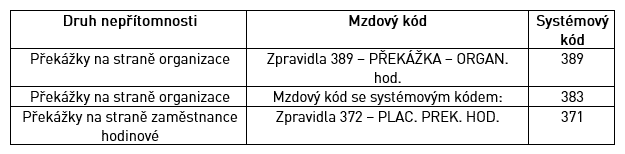
- Barriers on the side of the organisation (employer) hourly
- Barriers on the part of the hourly employee
- To the bookmark Sick leave (Employee card - Employment - Sick leave tab)which refers to:
- Temporary incapacity for work due to an occupational accident or disease
- Nursing a child under 10 years of age or another household member under Section 39 of the Sickness Insurance Act
- Nursing a child during school closure
- Long-term care allowance

Remark: Absences entered using user pay codes with the above system codes will always be counted as time worked for holiday entitlement purposes.
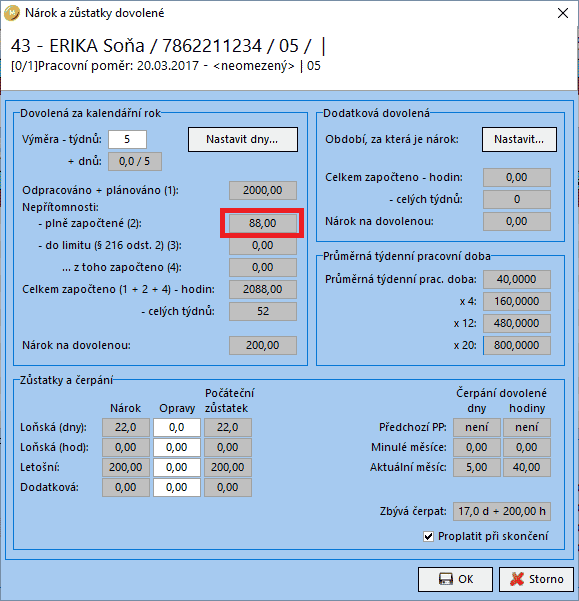
Compensatory time fully credited for holiday entitlement you can see in the window Entitlement and leave balances, line Absences - fully accounted for (2) (Employee tab - Employment - Compensation tab - Holiday entitlement and balances window (opened via the button with three dots)).
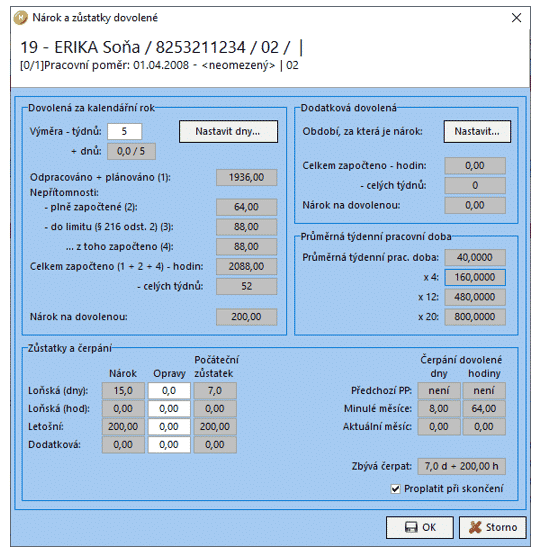
In the payroll table, for pay codes that belong to the category of fully credited periods in terms of holiday entitlement, the flag "P" is in the credits section, in the third column (field "D" - Holiday).

Example:
The employee works a five-day schedule from Monday to Friday. His weekly working time is 40 hours (8 hours each day from Monday to Friday). In February, he will take his annual leave from 1 February 2021 to 5 February 2021, which in his case is five working days of eight hours each, i.e. 40 hours. From 17.2.2021 to 24.2.2021, he draws nursing allowance for a child up to the age of ten. This is 8 calendar days for him, but 6 working days, which is 48 hours. At the end of this accounting period 02/2021, this employee has 88 hours fully credited as worked in terms of leave entitlement (40 hours leave + 48 hours nursing).